Pre-application for STAR Graduate Fellowship
Page1
1. Name: Thomas, Jonathan Stephen
Current Address: 1218 Byrne Ave. Apt E-4,
Cookeville, TN 38501
Permanent Address: 1005 C. Rody Rd.
McMinnville, TN
Home Telephone: 931-528-7672
Work Telephone: 931-646-2429
Fax: 931-646-2192
E-Mail: jst3857@tntech.edu
Gender: Male
Race: White
Page 2
Statement of Objectives:
In light of the recent study of food vesicles containing the bacteria Legionella pneumophilia released by amoebae at Tennessee Tech University, there is a new interest in the same type of food vesicles containing L. pneumophilia released by the ciliate Tetrahymena. Legionella encased within these vesicles have shown increased resistance to biocides and heating. However, the affects of humidity and desiccation on the Legionella within vesicles have not been addressed. The objective of this study is to test the hypothesis that there is no difference in the number of viable recoverable Legionella pneumophilia between those in vesicles after ingestion by the ciliate Tetrahymena and those not within vesicles when subjected to desiccation.
All laboratory proceedings are being performed in the Center for the Management, Utilization and Protection of Water Resources, Tennessee Technological University, Cookeville, Tennessee, in conjunction with Dr. Sharon Berk and Dr. John Gunderson of the Department of Biology. In the experiment, L. pneumophilia bacteria will be fed to groups of the Tetrahymena ciliates. After letting the Tetrahymena produce vesicles, the vesicles will be separated into two groups, one with vesicles containing Legionella and one with free-living Legionella.
Both sets will be dried in a desiccating chamber, and attempts will
be made to resuscitate the Legionella by adding water and growing the
bacteria on a selective media.
Due
to the important public health implications concerning Leigonella
pneumophilia, this study yields high expectations. We expect that the L.
pneumophilia within vesicles will exhibit resistance to desiccation
while free-living L. pneumophilia will not. If the L. pneumophilia
within vesicles does show resistance to desiccation, the conclusions may
help explain the spread of Legoinnaire's Disease and provide a foundation
for further research in this area.
Pages 4-8
12. Narrative Statement
In 1980, the first reports were made concerning the multiplication of Legionella pneumophilia within amoebae (Neumeister et al 2000; Kwaik 1996; Michel et al 1997). Recent studies have shown that Legionnaire's Disease can be spread by aerosolized food vacuoles released by free-living amoebae after engulfing the bacteria living in water within cooling towers (Berk et al 1998).
There is a new interest in the specific relationship of L. pneumophilia to the ciliate Tetrahymena. Vesicles secreted by Tetrahymena are very similar in chemical composition to vesicles secreted by amoebae (Kwaik 1996). However, unlike free-living amoebae, which typically lyse releasing large vesicles filled with Legionella after digesting them (Michel et al 1997), Tetrahymena do not undergo lysis when they ingest Legionella (McNealy et al 2000; Michel and Hauroder-Pilippczyk 1994). Instead, the Legionella move through the digestive system of Tetrahymena very rapidly and are released into the environment, allowing a single Tetrahymena ciliate to ingest a greater number of Legionella and release a far greater number of vesicles containing Legionella. For this reason, Tetrahymena is a more suitable organism for the study of vesicles.
The Legionella within these vesicles exhibit increased resistance to biocides and high temperatures (Barker 1999; Cirillo 1999). Perhaps they are resistant to desiccation as well. If this were true, it would explain how some vesicles could travel as aerosol particles for long distances from the cooling towers and infect humans, causing Legionnaire's Disease (Berk et al 1998; Barker 1999, Cirillo 1999). The objective of this study is to test the hypothesis that there is no difference in the number of recoverable viable Legionella pneumophilia between those encased within food vesicles after ingestion and release by Tetrahymena and those living free in the water of cooling towers.
Twenty-four hours before feeding the Legionella to the Tetrahymena, a standard curve of number of Legionella present vs. optical density will developed to calculate the optimal starting amount of Legionella to feed the ciliates, in order to maximize vesicle production (Fig. 1). For optical density reading, a microplate reader will be used at a wavelength of 450 nm. Four ten-fold dilutions of 100 microliters of a suspension of L. pneumophilia in Tris-buffered salts solution (TBSS) will be placed in four different microwells of a microplate. The microplate will then be placed in a microplate reader to calculate an optical density ratio. J. Gunderson has advised to verify the amount of bacteria present in the stock solution will be correct (personal communication). Acridine Orange (A/O) will be used as a staining agent to count the number of bacteria present. For this experiment 0.1 % (w/v) Acridine Orange in two percent formaldehyde will be used. Then, 0.1 ml A/O will be added to a 1 ml sample of the sterile water suspension of Legionella. After 2 minutes of staining, the mixture will be placed in a Millipore filter apparatus, and using 0.22-micrometer black-stained filters the mixture will be gently vacuum filtered and rinsed with 2 ml of deionized water. The bacteria will then placed on a slide with a cover slip.
Fluorescence microscopy will then be used to estimate the number of Legionella present in the same manner used by Berk (Berk et al 1998).
The Tetrahymena will be grown in plate count broth. The ciliates will be washed, then resuspended in Tris-buffered salts solution (TBSS) (Berk et al 1998). Then, 0.15 ml of stock Legionella solution will be placed in a beaker containing 6 ml Tetrahymena. The solution will then be vortexed to break down the Legionella colonies into smaller strands, and the new suspension washed and again resuspended in TBSS. The ciliates will be allowed to expel food vesicles for 24 hours (McNealy et al 2000).
Next, a lab technique designed by J. Gunderson will be used to harvest the vesicles (personal communication). Formaldehyde will be added to the solution, killing the Tetrahymena. The Tetrahymena will be allowed to sink to the bottom of the beaker, while the vesicles remain in solution. The secreted vesicles will be separated by placing the beaker in the sonicator for 1 minute . A solution of 1 ml of vesicles containing Legionella will be placed in a 30-ml beaker. Simultaneously, the same volume of suspended Legoinella not in vesicles will be placed in another sterile 30-ml beaker. The beakers will be placed in a drying chamber and the relative humidity will then be observed.
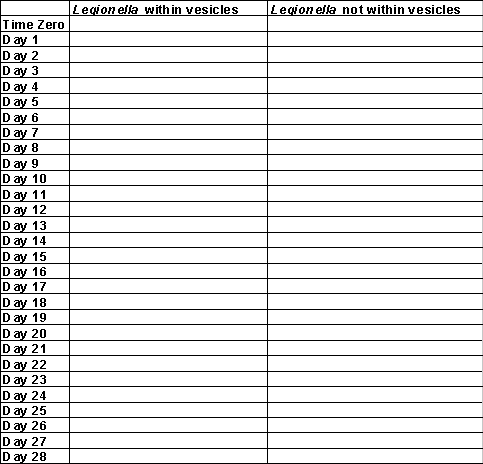
At three time periods, attempts will be made to recover viable Legionella from the beakers by adding 1 ml sterile water to the dried down material, and then letting it sit to loosen. To obtain an accurate number of countable colony-forming units (CFUs), three ten-fold dilutions will be made of each separate solution, with six plates for each dilution to ensure accuracy. Each dilution will then be placed in a sonicating bath to remove the Legionella from the broth. A new suspension of Legionella will be formed by adding water to the isolate. A loopful of the Legionella suspension will be removed and transferred via the spread plate technique to BCYE agar plates. Observation of recovery of colonies will be recorded (Table 1). Colonies will then be counted by using direct plate counts. This technique will be used at 24 hours, 72 hours, and 22 days after the initial subjection of the L. pneumophilia to desiccation.
We
hope this experiment will prove that Legionella
that are expelled within food vacuoles from Tetrahymena
will exhibit an increased resistance to desiccation in their environment.
Protection from these vesicles may also be the cause for resistance to
biocides and high temperature of Legionella pneumophilia.
In addition, this experiment may help to explain how aerosol particles
from cooling towers miles away can cause Legionnaire's Disease through
inhalation. Proof of this mechanism
of epidemiology would have major public health applications.
Table 1. Observed recovery of desiccated Legionella pneumophilia at various time periods.
13. Transcript Data
| Institution | Year | Course # | Title | Credit Hrs | Grade |
| TTU | 1996 | 744 | Special Project | 5 | In Progress |
| TTU | 1996 | 740 | Topology | 5 | In Progress |
| TTU | 1996 | 735 | Number Theory | 4 | In Progress |
| TTU | 1996 | 722 | Adv Topics in Chaos | 4 | In Progress |
| TTU | 1996 | 719 | Special Project | 5 | A |
| TTU | 1996 | 716 | Transfinite math | 5 | A |
| TTU | 1995 | Ph-96 | Number Theory | 8 | A |
| TTU | 1995 | Ph-85 | Euclidian Geometry | 4 | A |
| TTU | 1995 | R-65 | Applied Physics | 4 | A |
| TTU | 1995 | R-64 | Applications Theory | 4 | A |
| TTU | 1994 | R-63 | Linear Geometry | 4 | A |
| TTU | 1994 | R-62 | Basic Java Language | 4 | P |
| TTU | 1994 | R-61 | C++ Programming | 5 | P |
| TTU | 1994 | R-60 | Special Project | 4 | A |
| TTU | 1994 | R-59 | Research Project | 4 | A |
| TTU | 1993 | 620 | Applied Geometry | 4 | A |
| TTU | 1993 | 621 | Advanced Calculus | 4 | A |
| TTU | 1993 | 666 | Computing | 4 | A |
| TTU | 1992 | 431 | Advanced Math | 4 | B+ |
| TTU | 1992 | 444 | Physical Education | 4 | P |
| TTU | 1991 | 522 | English | 4 | C |
| TTU | 1991 | 101 | Math | 4 | A |
| U. Iowa | 1991 | 122 | Geography | 4 | A |
| U. Iowa | 1991 | 177 | Statistics | 4 | A |